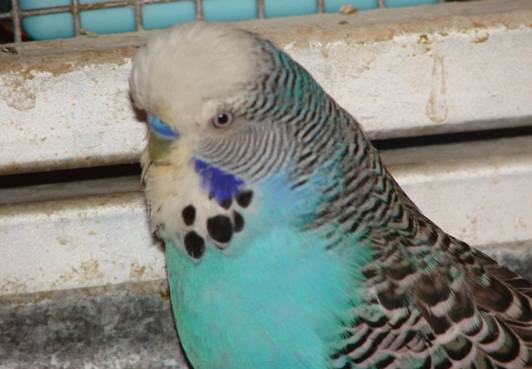
The common wisdom surrounding opalescence is that it is a problem
evident in Normal color budgerigars that has apparently crept in from the breeding
of Normals to the Opaline color variety. Moreover, that this color anomaly resulted
from some crossover or "bleeding" of standard Opaline genetic material to the Normal
colored bird. While I agree that this anomaly does seem to have been spread through
a great number of Normal Exhibition birds through breeding with Opalines, it is an
inherited characteristic that is separate from the standard Opaline variety and should
be clarified as a fault in Opalines just as in Normals.
Opalescence is the substitution of the desired melanin, or dark, pigment
found in the budgie's shell, or bar, patterning on the top side of the bird as when
seen in flight, by an infusion of the breast color. For example, in a blue bird
these shells will not be monochromatically dark brown, black, or slate as expected
but will be substituted by or blended with blue. The areas most often affected are
the back of the head and, to a lesser extent, the shell pattern on wings.
In Opalines, the wings are expected to have the breast color substitute
the clear yellow or white background to the shell pattern on the wings. What has
become acceptable is for this breast color and melanistic barring to continue on
the head. Let me clarify that this coloring of the head is against the ABS Opaline
standard which states that the head should ideally be pure white or yellow consistent
with the birds color series.
I have found old published photographs that clearly show white or
yellow heads on pet quality opalines, albeit with ghost barring. Moreover, the
ghost barring is neutral melanin without breast color suffusion.
My conjecture from this evidence is that the opalescence we often
think of as an unavoidable relic of opalescent breeding, is really a "sport"
introduction that some may have preferred in the Opaline look, or at least
found minimally objectionable. When this separately inherited characteristic
made its way into the Normals however, the result was more universally unappreciated.